

As of April 2026, 44% of all new daily uploads to Deezer — roughly 75,000 tracks per day — are AI-generated, and the platform has already demonetized 85% of streams flagged as fraudulent [1]. That number isn’t a warning shot. It’s a wake-up call.
The AI music generator revolution is real. The opportunity is massive. But the artists cashing in long-term aren’t the ones moving fast and breaking rules — they’re the ones moving smart and building clean. Whether you’re an independent artist, a manager running a roster, or a label owner scaling your catalog, the way you use AI music tools right now will determine whether you’re building an asset or a liability.
This guide breaks down exactly what’s legal, what’s ethical, and how to monetize AI-assisted music in 2026 without putting your career — or your catalog — at risk.
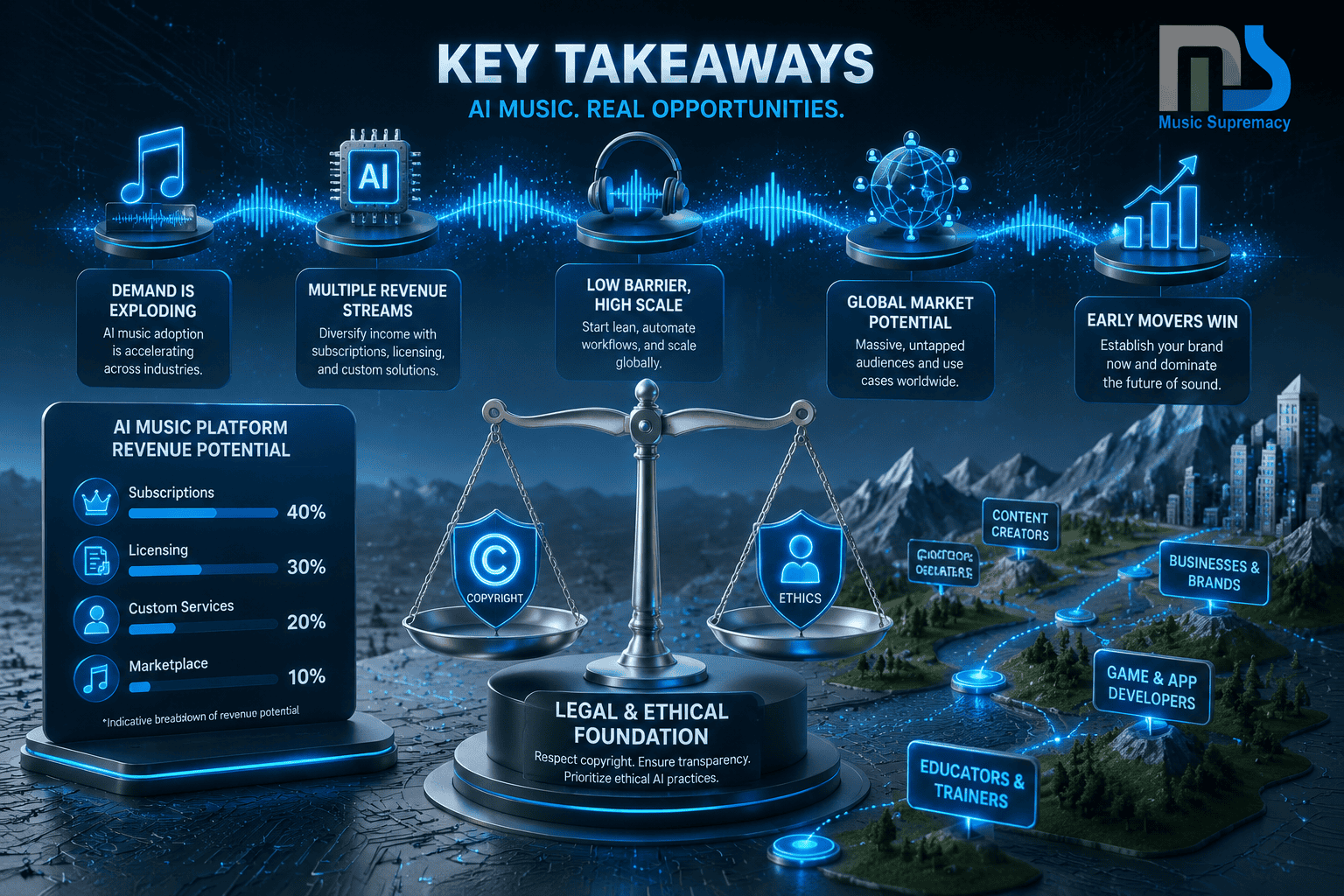
Key Takeaways 🎯
- Pure AI output is not copyrightable in the US — only human-contributed elements qualify for protection [1][10]
- Major labels have settled with Suno and Udio, but unlicensed AI music platforms face ongoing legal risk [1]
- Deezer, Spotify, and YouTube are actively flagging, demonetizing, and removing AI-generated content that isn’t properly disclosed [1]
- The EU AI Act mandates machine-readable labeling of synthetic audio starting August 2, 2026 [7]
- Ethical monetization requires human creative input, proper disclosure, and licensed AI tools — not just any AI music generator
The Legal Landscape: What the Lawsuits Actually Mean for Artists
The music industry’s legal battle with AI isn’t background noise anymore. It’s the main stage — and artists need to understand what’s happening before they build their strategy around tools that might disappear or change overnight.
The Major Label Settlements (And What They Changed)
Here’s the fast version of what went down:
| Label | Platform | Outcome |
|---|---|---|
| Warner Music Group | Suno | Settled Nov 2025 — licensed models with download caps [1] |
| UMG | Udio | Settled Oct 2025 — joint “walled garden” platform [1] |
| Warner Music Group | Udio | Settled late 2025 — licensed models [1] |
| Sony, Warner, UMG | Klay Vision | Licensed deals Nov 2025 — no lawsuits [1] |
Klay Vision’s approach is the blueprint. They built a remix platform using only licensed training data — no lawsuits, no drama, just a clean enterprise model that Sony, Warner, and UMG all signed onto [1]. Analysts at Opus.pro are calling this the “licensed product category” shift — the unlicensed era is closing fast [7].
Meanwhile, UMG vs. Suno is still active as of April 2026, with settlement talks hitting an impasse. Sony’s cases against Suno and Udio expect a fair-use ruling by summer 2026 [1]. The likely outcome? A “mixed ruling” — training on legally licensed data may qualify as fair use, but training on pirated sources will not be protected [1].
💡 What this means for you: If you’re using an AI music generator, check whether it operates on licensed training data. Unlicensed tools carry legal risk that could affect your ability to distribute and monetize.
The Copyright Reality in 2026
The US Copyright Office has made its position clear: pure AI output is not copyrightable [1][10]. No human authorship = no copyright protection. That’s not an opinion — it’s current guidance.
But here’s where it gets strategic. AI-assisted music — where a human contributes substantially to lyrics, melody direction, arrangement choices, or production decisions — can be registered for copyright, provided the AI use is disclosed and only the human-created elements are claimed [3][10].
This is the line every artist needs to understand:
- ❌ Fully AI-generated track with no human edits → Not copyrightable → Can’t be monetized safely
- ✅ AI-assisted track with meaningful human creative input → Registrable → Monetizable with proper disclosure
For a deeper dive into the business framework around music rights and ownership, check out The Ultimate Music Business Guide for Artists in 2026.
Platform Rules: Where AI Music Can (and Cannot) Make Money
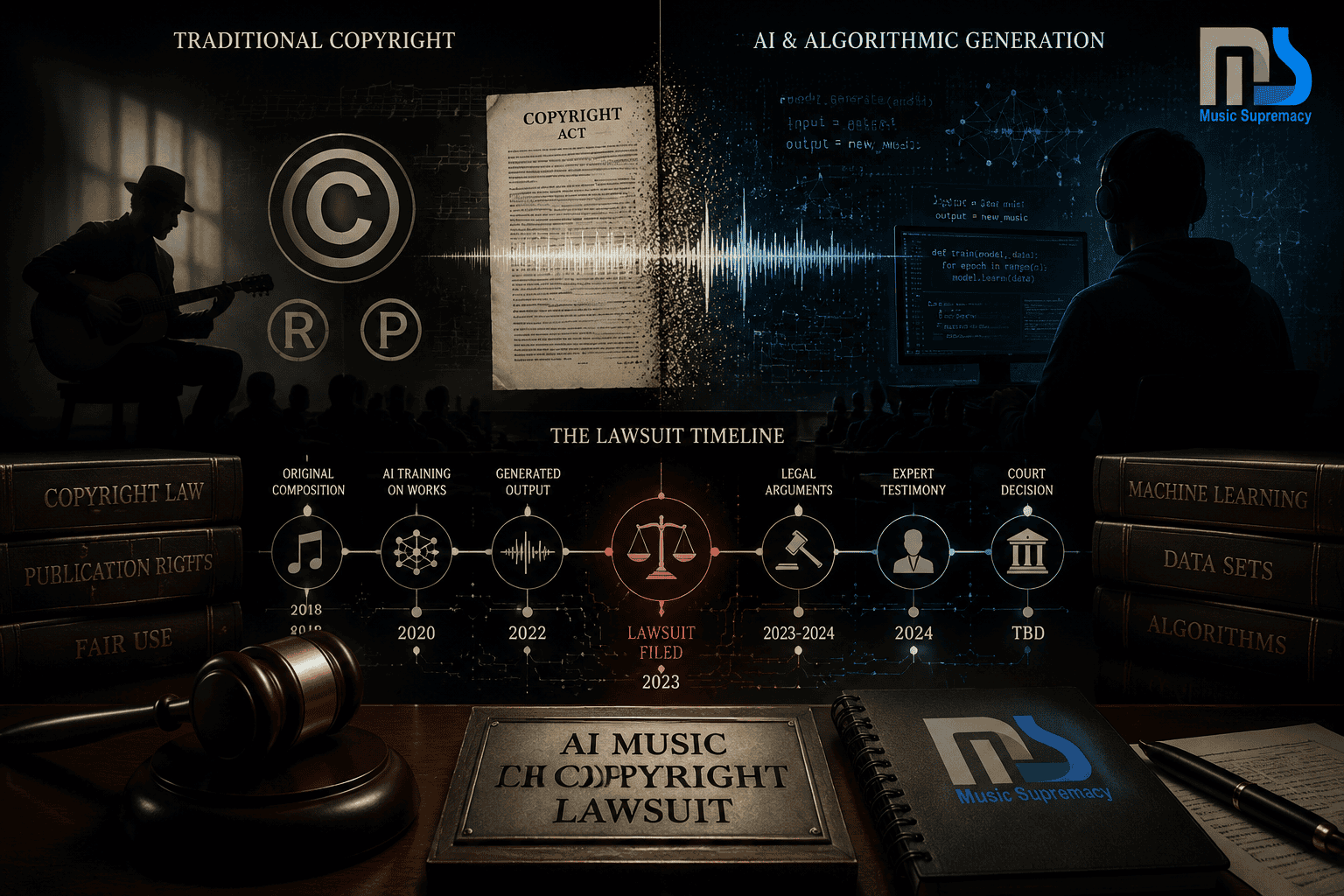
Understanding the legal framework is step one. Understanding where and how platforms are enforcing it is step two — because the rules are tightening fast.
Spotify, YouTube & Deezer: The New AI Enforcement Era
Spotify launched its AI-credits beta on April 16, 2026, allowing artists to voluntarily disclose AI involvement in their tracks [1]. This isn’t optional for long — voluntary disclosure today becomes mandatory policy tomorrow.
YouTube expanded its likeness detection system to celebrities on April 21, 2026, enabling takedowns of AI-generated content that mimics real artists without consent [1]. If your AI music generator produces vocals that sound like a known artist, you’re at risk.
Deezer is the most aggressive. They’re tagging AI-generated content, demonetizing 85% of streams flagged as fraudulent, and excluding AI tracks from recommendations [1]. If you’re uploading AI music to Deezer without disclosure, you’re likely already losing money — or about to.
The EU AI Act: A Hard Deadline for Disclosure
August 2, 2026 is a date every artist and label owner needs to mark. That’s when EU AI Act Article 50 mandates machine-readable labeling of synthetic audio [7]. If you’re distributing music in Europe — and streaming platforms are global — this applies to you.
The US NO FAKES Act has been reintroduced but remains stalled as of April 2026 [1]. Don’t wait for US legislation to catch up. Build disclosure habits now.
Platform-by-Platform Quick Reference 📋
| Platform | AI Policy (2026) | Monetization Status |
|---|---|---|
| Spotify | Voluntary AI disclosure beta | Allowed with disclosure |
| YouTube | Likeness detection active | Takedowns for undisclosed AI vocals |
| Deezer | Active tagging + demonetization | 85% fraudulent streams demonetized [1] |
| Apple Music | Disclosure encouraged | Policy evolving |
| Udio (post-settlement) | Walled garden — no downloads | Limited monetization [1] |
How to Use an AI Music Generator Ethically (And Protect Your Revenue)

Here’s the truth: ethical AI music creation isn’t just the right thing to do — it’s the only sustainable monetization strategy. Platforms are getting smarter. Labels are getting more aggressive. And audiences are getting more aware.
The Ethical Framework That Actually Works
Soundverse AI’s 2026 Ethical Framework outlines three non-negotiables for sustainable AI music monetization [6]:
- Consent-based training data — Only use AI tools trained on licensed or consented music
- Traceable attribution — Ensure your AI tool uses watermarks or attribution systems
- Recurring artist royalties — Support platforms that pay back to the artists whose work trained the model
This isn’t charity. It’s smart business. The platforms that survive the next wave of lawsuits and regulation will be the ones operating on clean data. Your music monetization depends on theirs.
The Human Creative Stack: Where You Add Value
The more human creative input you add, the stronger your copyright claim and your monetization position. Here’s how to build what’s being called the “Human Creative Stack”:
- Write your own lyrics — Even if the AI generates melody, your words are yours
- Direct the arrangement — Make deliberate choices about structure, key, tempo
- Edit the output — Modify, layer, and produce on top of AI-generated elements
- Record original elements — Add your voice, an instrument, or live performance
- Make creative decisions — Every intentional choice strengthens your authorship claim
🎤 Pro tip: Document your creative process. Screenshots of prompts, version histories, and production notes can support a copyright registration claim if challenged.
For artists using Suno specifically, Music Prompts for Suno: Complete 2026 Guide for Artists shows exactly how to craft prompts that keep human creative direction front and center.
Choosing the Right AI Music Generator
Not all AI music tools carry the same legal risk. Before you commit to a platform, ask:
- Does it use licensed training data?
- Does it offer download rights for commercial use?
- Does it provide attribution or watermarking?
- Has it faced or settled major label lawsuits?
For a full breakdown of the top tools and their current legal status, see the Best AI Music Generators 2026: Top Tools Compared guide. And if you want to explore the broader production ecosystem, Best Music Production Software in 2026: Top DAWs Reviewed covers how AI tools integrate with professional DAWs.
Monetization Strategies That Actually Hold Up in 2026
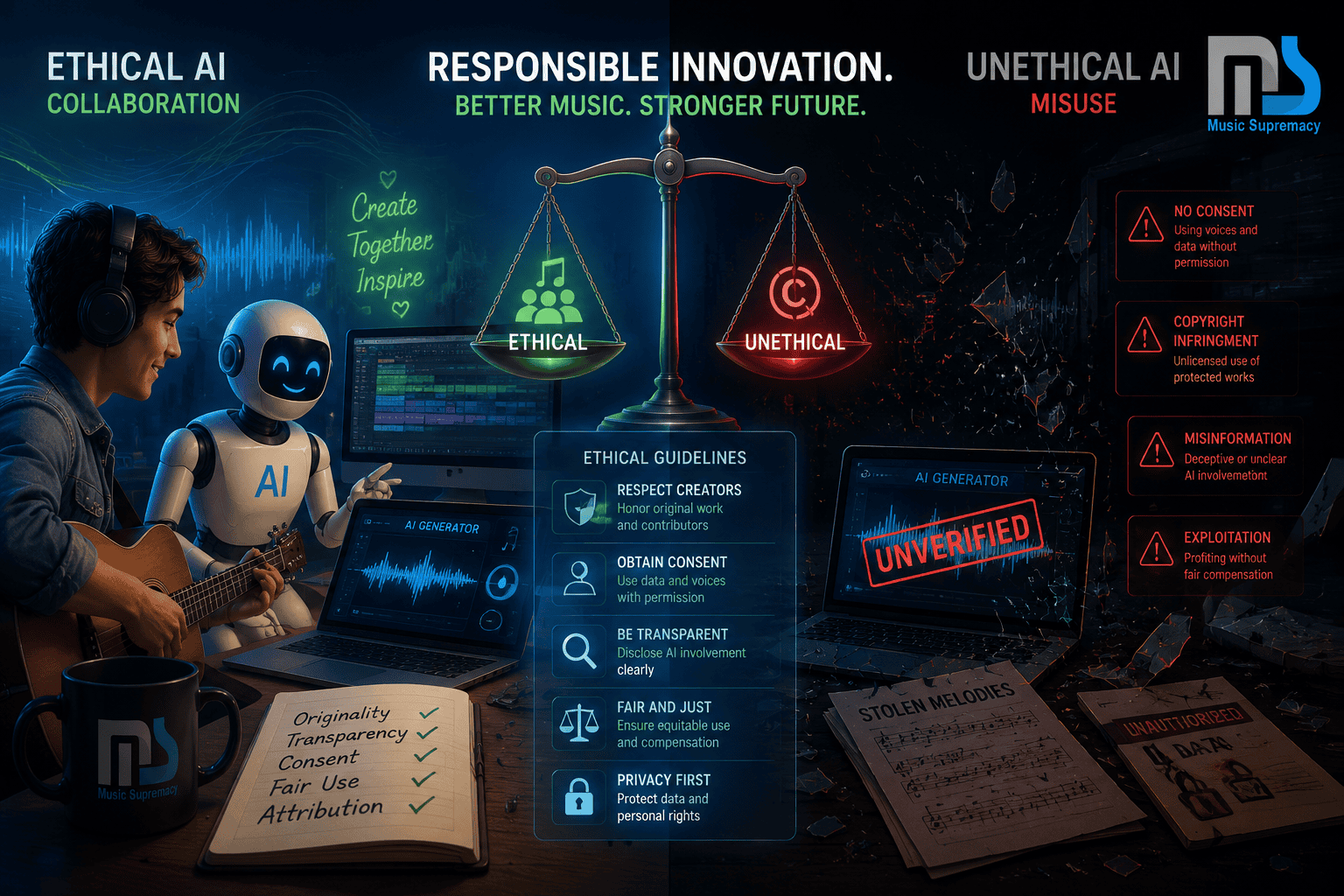
Legal compliance opens the door. Smart monetization strategy is what builds the career. Here’s how to stack revenue from AI-assisted music without putting your catalog at risk.
1. 🎵 Streaming Revenue (The Right Way)
Streaming is still the foundation — but only if you’re doing it clean:
- Use AI tools with licensed training data
- Disclose AI involvement on platforms that require or request it
- Ensure substantial human creative contribution before distribution
- Register human-created elements with the Copyright Office
At Suno’s $300M ARR and $2.45B valuation, the platform is scaling fast — but its licensed models now come with download caps post-settlement [1][7]. Know your tool’s terms before you build a catalog on it.
2. 🎬 Sync Licensing
Sync licensing — placing music in film, TV, ads, and games — is one of the highest-value revenue streams for independent artists. AI-assisted music can absolutely qualify, but:
- The music must have registrable copyright (human elements present)
- Disclosure of AI involvement may be required by the licensee
- Fully AI-generated tracks with no human authorship are extremely difficult to license
This is where the Human Creative Stack pays off. The more original your contribution, the more valuable and licensable your catalog becomes.
3. 🤝 Fan-Direct Monetization
This is where independent artists have the biggest edge. AI music tools can dramatically increase your output — which means more content to fuel fan engagement, exclusives, and direct revenue.
Strategies that work:
- Exclusive AI-assisted demos for superfan tiers on Patreon or your own platform
- Co-creation experiences — let fans submit prompts, you produce the track (check out Suno AI for Superfan Co-Creation for a full playbook)
- Limited edition releases — AI-assisted tracks with unique artwork and download rights
- Membership content — behind-the-scenes of your AI production process
For building the fan infrastructure that makes this work, Digital Wallet Cards for Music Artist List Building shows how to capture and retain fans outside of algorithm-dependent platforms.
4. 🎙️ Beat & Track Sales
Selling beats and tracks directly is one of the cleanest monetization paths for AI-assisted music — especially when you add significant production value on top of AI-generated foundations. Platforms like BeatStars and your own store allow direct sales without the disclosure complexities of streaming.
Check out the full guide on selling your music and beats online to build a direct revenue channel that you control.
5. 💼 Sponsorships & Brand Deals
AI music production speed is a genuine asset for brand partnerships. Faster turnaround, lower production costs, and consistent output make AI-assisted artists attractive for brands needing custom music content. The sponsorships and monetization guide breaks down how to pitch and structure these deals.
Revenue Stack Summary 💰
| Revenue Stream | AI Music Compatibility | Key Requirement |
|---|---|---|
| Streaming | ✅ High | Disclosure + human input |
| Sync Licensing | ✅ Medium | Registrable copyright |
| Beat Sales | ✅ High | Commercial use license from AI tool |
| Fan Direct | ✅ Very High | Engagement strategy |
| Sponsorships | ✅ High | Consistent output + audience |
Disclosure Best Practices: Build Trust, Not Just Compliance
Disclosure isn’t just a legal requirement — it’s a brand strategy. Artists who are transparent about their AI use are building trust with fans at a time when authenticity is the most valuable currency in music.
How to Disclose AI Use Professionally
- On streaming platforms: Use metadata fields for AI disclosure where available (Spotify’s beta system, for example)
- On social media: A simple, confident statement — “This track was created with AI assistance and my own production direction” — builds credibility
- In press releases and pitches: Note AI involvement upfront when pitching to sync libraries or media
- In copyright registration: Clearly identify which elements are human-created when filing
🔑 The mindset shift: Disclosure isn’t weakness. It’s ownership. Artists who own their process — including their tools — command more respect than those who hide it.
For artists building their content presence around their music creation process, How to Become a Musician Content Creator in 2026 shows how to turn transparency into audience growth.
Conclusion: The Artists Who Win Are the Ones Who Build Clean
The AI music generator era isn’t coming — it’s here. And the artists who thrive in it won’t be the ones who moved fastest with the least regard for the rules. They’ll be the ones who understood the landscape, built with integrity, and monetized with strategy.
Here’s your action plan:
- ✅ Audit your AI tools — Are they using licensed training data? Do they offer commercial download rights?
- ✅ Add human creative input — Write lyrics, direct arrangements, produce on top of AI output
- ✅ Disclose proactively — Don’t wait for platforms to force it; build the habit now
- ✅ Register your human elements — File copyright for the parts you created
- ✅ Diversify your revenue stack — Streaming + sync + fan-direct + beats + sponsorships
- ✅ Mark August 2, 2026 — EU AI Act labeling requirements go live; ensure compliance
The legal framework is still evolving. The platforms are still calibrating. But the direction is clear: clean, disclosed, human-contributed AI music is the future of independent music creation. Build that way from day one, and you’ll own what you create.
References
[1] Music Industry AI Lawsuits Tracker 2026 – https://www.chartlex.com/blog/business/music-industry-ai-lawsuits-tracker-2026
[3] AI Music Law: What Creators Can And Cannot Do 2026 – https://jackrighteous.com/blogs/creator-commerce/ai-music-law-what-creators-can-and-cannot-do-2026
[5] Every AI Music Lawsuit Tracked – https://thevocalmarket.com/blogs/enterprise/every-ai-music-lawsuit-tracked
[6] AI Music And Sustainable Monetization Ethics – https://www.soundverse.ai/blog/article/ai-music-and-sustainable-monetization-ethics-0811
[7] AI Music News April 2026 – https://www.opus.pro/blog/ai-music-news-april-2026
[9] AI Music Copyright Cases Timeline – https://dynamoi.com/learn/ai-music-distribution/ai-music-copyright-cases-timeline
[10] AI Music Copyright 2026 – https://musicmake.ai/blog/ai-music-copyright-2026