
Last updated: March 18, 2026
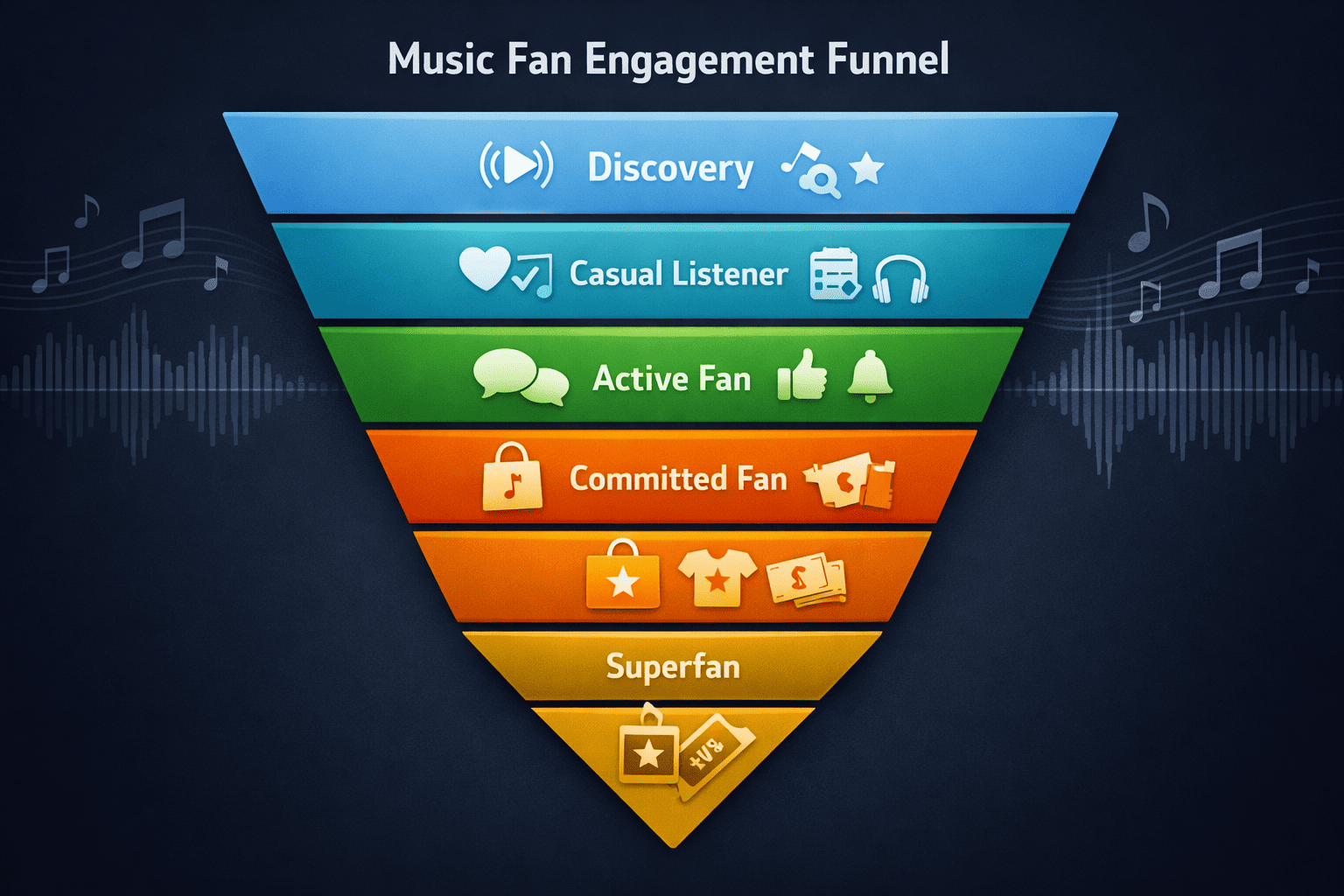
The fan engagement funnel is a framework that maps how listeners move from first discovering an artist to becoming deeply invested superfans, and it works by stacking intentional social touchpoints at each stage. Unlike traditional marketing funnels built around transactions, this model tracks emotional progression. For independent artists in 2026, understanding the fan engagement funnel: converting casual listeners to superfans through strategic social touchpoints is the difference between chasing streams and building a sustainable career.
Key Takeaways
- The fan engagement funnel has five stages: Discovery, Casual Listener, Active Fan, Committed Fan, and Superfan [7][1]
- Superfans engage across five or more channels, not just one streaming platform [7]
- Instagram DMs, Reels, and broadcast channels are the highest-impact touchpoints for moving fans through the funnel in 2026
- Depth of connection matters more than width of reach; 1,000 superfans outperform 100,000 passive listeners in revenue
- No single funnel path exists anymore; fans take personalized, nonlinear routes to superfandom [8]
- Dark social (private shares, DMs) accounts for significant fan activity that standard analytics miss [2]
- Owned channels like email lists, SMS, and digital wallet cards give artists direct access independent of algorithms
- Each funnel stage requires different content types and engagement tactics
What Is the Fan Engagement Funnel and Why Does It Matter in 2026?
The fan engagement funnel is a model that segments your audience by how deeply they connect with your music, from someone who hears a song once to someone who buys every release, attends every show, and promotes your work without being asked. Luminate’s 2025 Year-End Report formalized this framework for the music industry, framing fans along a spectrum from passive streaming to active superfandom [7][1].
This matters because streaming revenue alone doesn’t sustain independent artists. A listener who streams your track once on a playlist generates fractions of a penny. A superfan who buys merch, attends shows, and shares your content with friends can generate hundreds of dollars annually. The funnel helps you identify where each fan sits and what action moves them deeper.
Industry analyst Grant Gelt from Single.xyz breaks it down simply: use social platforms for discovery, exclusive content for attraction, and owned platforms for retaining superfans [3].
What Are the Five Stages of the Fan Engagement Funnel?
Each stage represents a different level of emotional and behavioral investment. Here’s how they break down:
| Stage | Behavior | Primary Touchpoint | Goal |
|---|---|---|---|
| Discovery | Hears your music for the first time via algorithm, share, or ad | Reels, TikTok, Spotify playlists | Capture attention |
| Casual Listener | Streams a few songs, maybe follows on one platform | Streaming profiles, social feed | Earn a follow or save |
| Active Fan | Engages with posts, comments, shares content | Instagram Stories, comments, DMs | Start a conversation |
| Committed Fan | Joins email list, buys merch, attends shows | Email, SMS, digital wallet cards | Build direct access |
| Superfan | Advocates for you, creates UGC, buys everything | Exclusive communities, VIP access | Reward and retain |
The critical insight: most artists spend all their energy on Discovery and ignore everything below it [7][1]. The funnel only works when you build touchpoints at every stage.

How Do Strategic Social Touchpoints Move Fans Through Each Stage?
A social touchpoint is any interaction where a fan engages with your content or brand. Strategic touchpoints are intentional actions designed to pull fans one stage deeper. Here’s what that looks like on Instagram specifically:
Discovery to Casual Listener:
- Post Reels using trending audio with your original twist. Learn more in our guide to promoting music on Reels for free
- Use a hashtag strategy built for relevance over volume
- End every Reel with a clear reason to follow (tease unreleased music, behind-the-scenes access)
Casual Listener to Active Fan:
- Reply to every comment within 30 minutes when possible. Speed signals that you value the connection
- Use Instagram Stories polls and Q&As to create low-effort engagement opportunities
- Share fan comments and tags to your Story, making fans feel seen
Active Fan to Committed Fan:
- Use Instagram DM onboarding sequences to welcome new followers with a personal voice note or exclusive link
- Offer a digital wallet card as a frictionless way to stay connected outside of social algorithms
- Invite fans to your email or SMS list with a clear value exchange (unreleased track, early ticket access)
Committed Fan to Superfan:
- Create exclusive fan experiences like private listening sessions or behind-the-scenes content
- Launch a rewards program for your most loyal listeners
- Give superfans first access to merch drops, features, and collaborations

Why Doesn’t a Single Linear Funnel Work Anymore?
DSM Sports highlighted in early 2026 that no single funnel exists anymore because fans consume content through personalized, nonlinear paths [8]. A fan might discover you through a friend’s Instagram DM (dark social), skip straight to buying a ticket, and only then start streaming your catalog.
This means you can’t rely on one platform or one content type. You need touchpoints spread across multiple channels so fans can enter and progress through the funnel from wherever they are.
Common mistake: Assuming every fan starts at Discovery. Many of your most valuable future superfans will enter through a private share or recommendation that never shows up in your analytics. Tracking dark social, the private shares and DMs that standard tools miss, can reveal this hidden activity over a 60-to-90-day window through brand lift measurement [2].
How Do You Build Owned Channels That Protect Against Algorithm Changes?
Social platforms are rented land. Algorithm shifts can cut your reach overnight. Owned channels give you direct, unfiltered access to your fans.
Priority owned channels for artists in 2026:
- Email list — Still the highest-converting channel for merch and ticket sales. Offer something exclusive to get signups.
- SMS/text marketing — Open rates far exceed email. Use for time-sensitive drops and show announcements. Explore SMS marketing strategies for musicians for setup guidance.
- Digital wallet cards — Fans save a card to Apple Wallet or Google Wallet, and you can push notifications directly to their lock screen.
- Instagram broadcast channels — One-to-many messaging that lives inside a platform fans already use daily.
- Microsites — A dedicated landing page for each release or campaign that you fully control.
Choose owned channels if: you have more than 500 engaged followers and want to reduce dependence on algorithmic reach. Start with one channel and expand as your capacity grows.

What Metrics Should You Track at Each Funnel Stage?
Vanity metrics like follower count don’t tell you how your funnel is performing. Track these instead:
| Funnel Stage | Key Metric | Why It Matters |
|---|---|---|
| Discovery | Reel reach, new profile visits | Shows if your content attracts new eyes |
| Casual Listener | Follow rate, Spotify saves | Measures if attention converts to interest |
| Active Fan | DM replies, Story interactions, comment rate | Indicates real two-way engagement |
| Committed Fan | Email signups, SMS opt-ins, wallet card saves | Proves fans want direct connection |
| Superfan | Merch purchases, UGC created, referral activity | Revenue and advocacy in action |
Stats Perform’s 2026 survey found that 70% of industry executives face increasing demands for digital content performance data [4]. The same principle applies to independent artists: if you can show clear funnel progression, you’re better positioned for sponsorships and monetization opportunities.

Common Mistakes That Stall the Fan Engagement Funnel
- Focusing only on top-of-funnel content. Reels and TikToks drive discovery, but without a next step, those viewers never become fans.
- Ignoring DMs. Direct messages are the most personal touchpoint on social media. Leaving them unanswered breaks trust.
- Asking for the sale too early. Don’t push merch on someone who just discovered you. Match the ask to the funnel stage.
- Not tracking dark social. Private shares, group chat links, and forwarded Stories drive real fan growth but stay invisible in standard analytics [2].
- Treating all fans the same. A casual listener and a superfan need different content, different frequency, and different offers.
Conclusion
The fan engagement funnel: converting casual listeners to superfans through strategic social touchpoints isn’t a one-time setup. It’s an ongoing system that grows with your audience. Start by mapping where your current fans sit in the funnel. Identify the biggest gap between stages, then build one or two touchpoints to bridge it. For most independent artists, the gap between Casual Listener and Active Fan is where the most opportunity lives, and Instagram DMs, Reels, and broadcast channels are the fastest tools to close it.
Your next move: pick one tactic from each funnel stage above and implement it this week. Track results for 30 days. Adjust. The artists who build this system now will own their fan relationships for years to come. Explore the full MusicSupremacy fan growth toolkit to accelerate your strategy.
FAQ
How long does it take to move a casual listener to a superfan? There’s no fixed timeline. Some fans progress in weeks if they connect deeply with a release or live experience. Others take months. Consistent touchpoints across multiple channels speed up the process.
Do I need a large following to use the fan engagement funnel? No. The funnel works at any scale. Artists with 500 followers can use DM onboarding and exclusive content to build a small but highly engaged superfan base.
Which social platform is best for the fan engagement funnel in 2026? Instagram currently offers the most complete set of funnel tools: Reels for discovery, Stories and comments for engagement, DMs for personal connection, and broadcast channels for owned-style communication.
What’s the difference between a superfan and a regular fan? Superfans engage across five or more channels, create content about your music without being asked, buy merch and tickets consistently, and actively recommend you to others [7].
How do I track fans who share my music in private messages? Standard analytics won’t capture dark social shares. Use unique links, UTM parameters, or trackable QR codes to measure private sharing activity over a 60-to-90-day window [2].
Should I automate DM responses or keep them personal? A hybrid approach works best. Use automation for initial welcome messages and link delivery, but respond personally to replies. Fans can tell the difference, and personal responses build stronger connections.
What content works best for converting active fans to committed fans? Exclusive or early-access content that requires opting into an owned channel: unreleased snippets sent via email, behind-the-scenes video for SMS subscribers, or private listening links through digital wallet cards.
Is the fan engagement funnel only for musicians? The model originated in broader marketing but has been specifically adapted for music by Luminate and industry analysts [7][1]. The principles apply to any creator building a loyal audience.
References
[1] Digital Fan Engagement Guide – https://socialrails.com/blog/digital-fan-engagement-guide [2] Dark Funnel Vs Dark Social How To Track Hidden Traffic In 2026 – https://insights.strategicabm.com/dark-funnel-vs-dark-social-how-to-track-hidden-traffic-in-2026 [3] 4 Proven Strategies To Turn Casual Fans Into Superfans – https://www.hypebot.com/4-proven-strategies-to-turn-casual-fans-into-superfans/ [4] 2026 Fan Engagement Monetisation And Ai Trends Survey – https://www.statsperform.com/resource/2026-fan-engagement-monetisation-and-ai-trends-survey/ [7] Fan Engagement In 2026 What The Data Is Really Telling Artists – https://allaboutmusicbusiness.com/fan-engagement-in-2026-what-the-data-is-really-telling-artists/ [8] Fan Development – https://dsmsports.net/category/fan-development/