Last updated: May 21, 2026
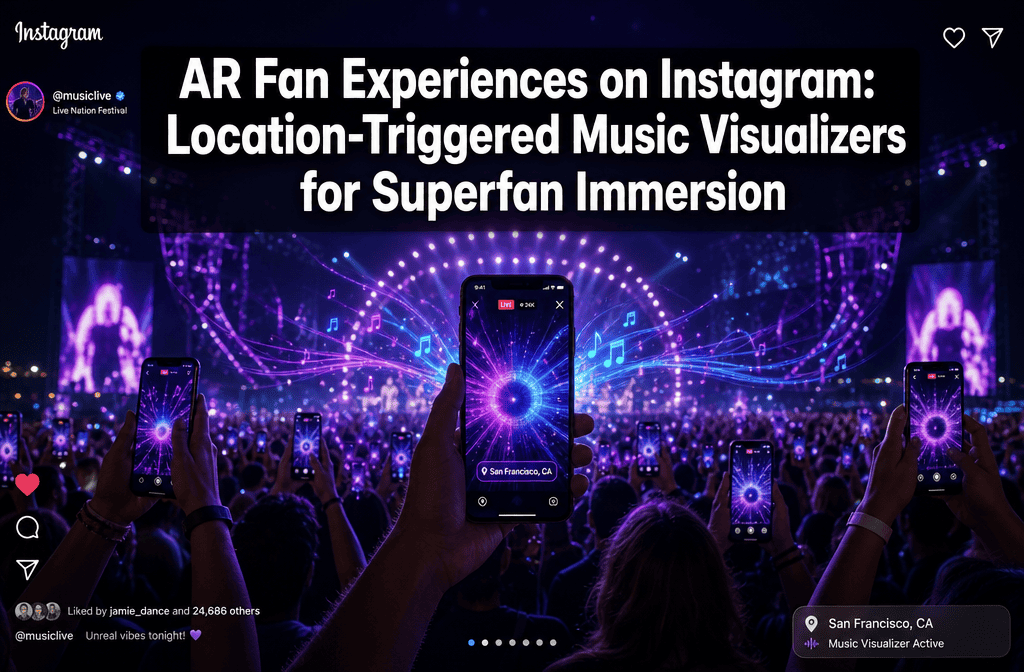
Quick Answer: AR fan experiences on Instagram use augmented reality music visualizers that activate when fans visit specific real-world locations — concert venues, pop-up shops, or city landmarks. While Meta shut down Spark AR Studio for third-party creators in January 2025 [7], artists in 2026 are building these experiences through webAR tools and distributing them via Instagram DMs and Stories. With 38% of Gen Z music engagers on Instagram qualifying as superfans (per Luminate’s 2026 study), location-triggered AR is one of the most effective ways to convert physical presence into deep digital engagement.
Key Takeaways
- 32% of daily music engagers on Instagram are superfans, rising to 38% among Gen Z — the highest concentration of any social platform besides YouTube.
- Location-triggered AR music visualizers reward fans who show up in person, directly aligning with Luminate’s superfan engagement “levers” like attending concerts and buying merch.
- Meta’s Spark AR Studio shutdown in January 2025 means custom Instagram-native AR filters are no longer available to third-party creators [7][10].
- The workaround: build in webAR platforms, then distribute links through Instagram DM automation and Stories.
- The global immersive entertainment market is projected to exceed $1 trillion by 2033, making AR music experiences a credible long-term investment.
- Independent artists can create basic AR visualizers for under $500 using tools like 8th Wall or Blippar.
- Privacy-first design (opt-in geofencing, no persistent tracking) is essential for fan trust.
What Exactly Are AR Music Visualizers on Instagram?
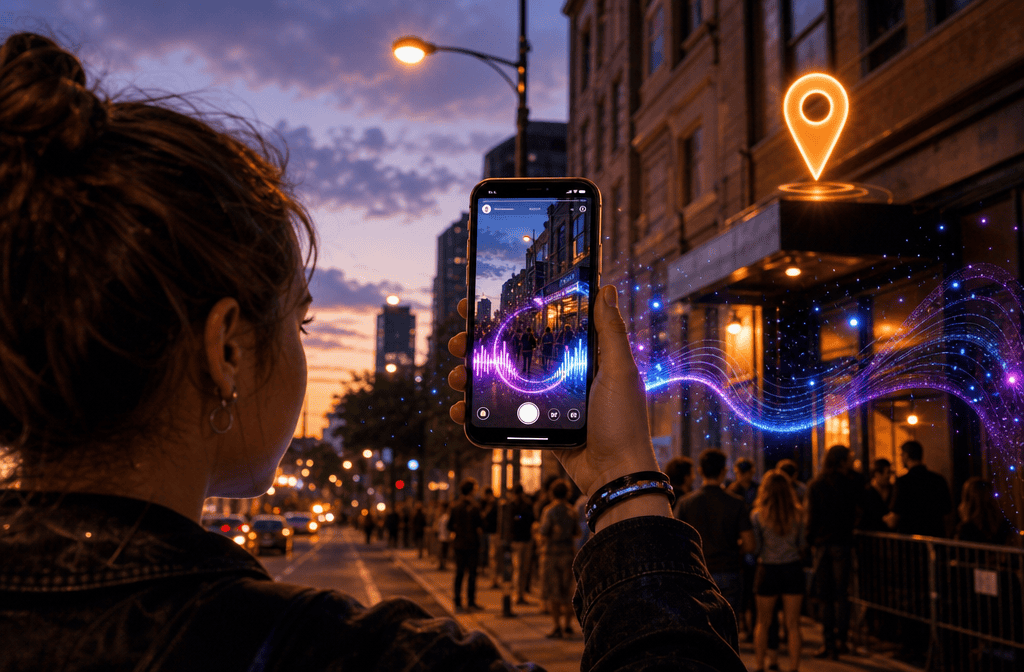
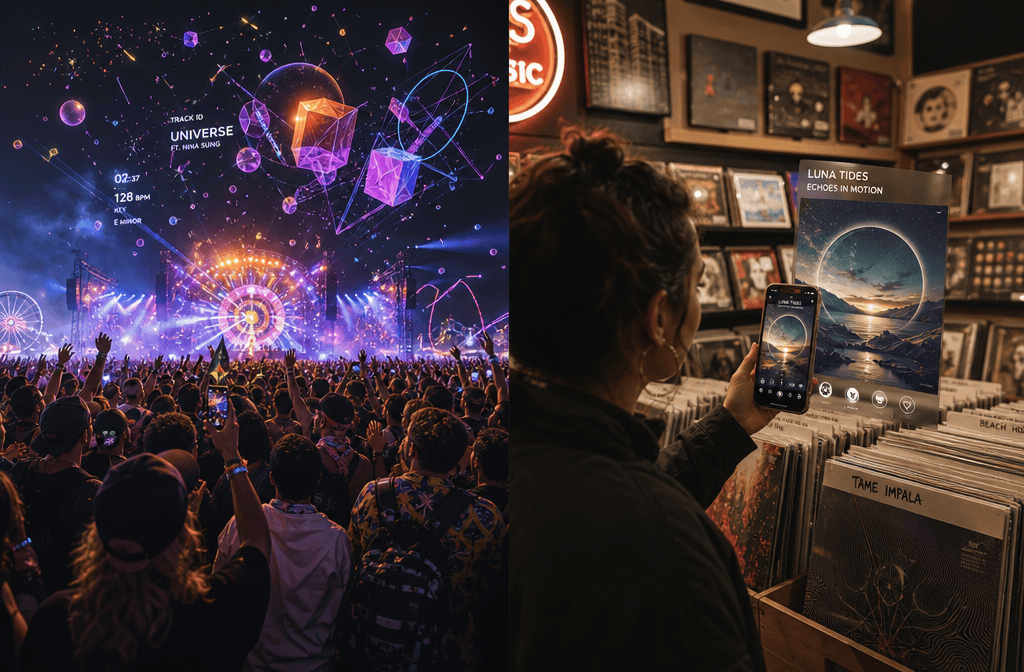
AR music visualizers are augmented reality effects that overlay sound-reactive graphics onto a fan’s real-world camera view. Think floating particle waves, pulsing geometric shapes, or album-art animations that move in sync with a track’s beat and frequency.
On Instagram, these effects historically lived as custom filters within Stories and Reels. After Meta shut down Spark AR Studio for third-party creators in January 2025 [7], the current approach involves:
- WebAR links shared through Instagram DMs, bio links, or Story swipe-ups
- Screen-captured UGC posted as Reels and Stories to amplify reach
- First-party Meta effects (limited selection, not customizable by artists)
AR practitioners like Groove Jones now recommend using Instagram as a distribution and amplification channel rather than the AR host itself [10]. The visualizer lives on the web; Instagram drives traffic and captures the social proof.
How Do Location-Triggered AR Experiences Work for Music Fans?
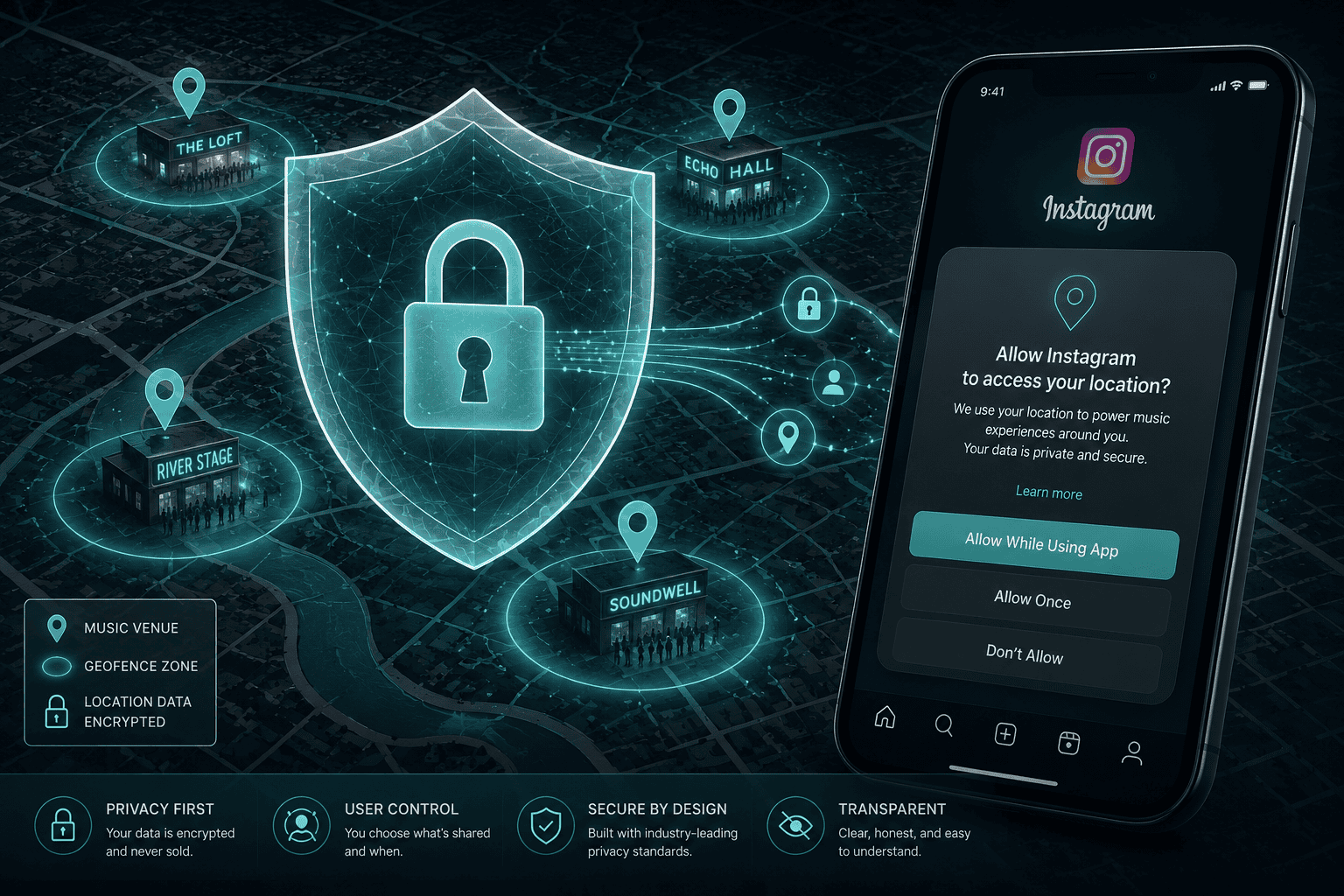
Location-triggered AR uses geofencing — a virtual boundary around a real-world coordinate — to unlock content only when a fan’s device is within a set radius. A fan walks within 200 meters of a venue, taps a link in their DMs, and the AR visualizer activates on their phone’s camera.
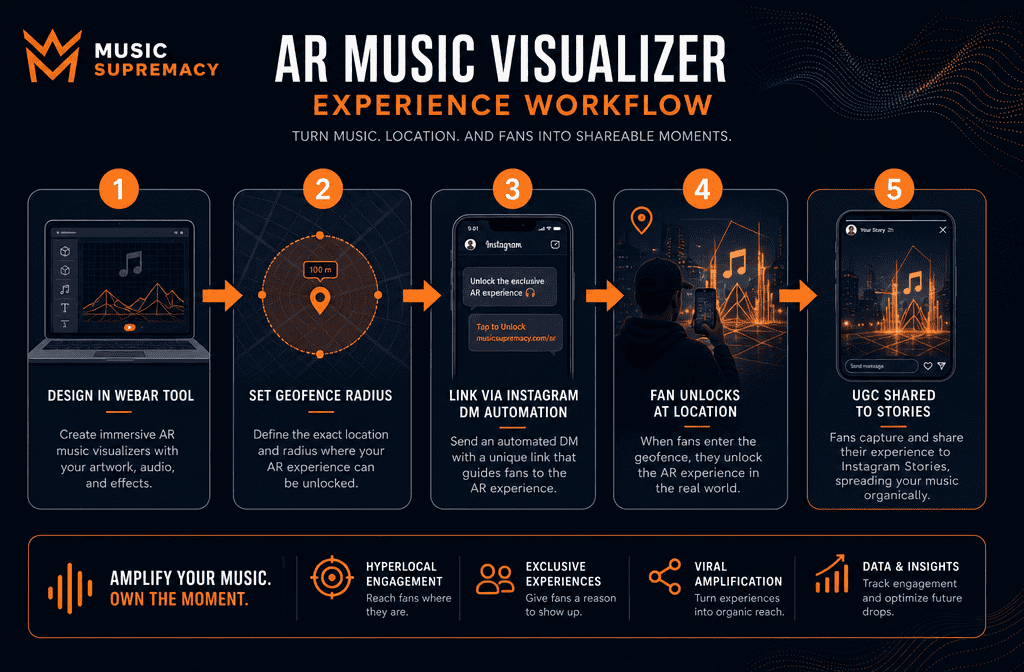
The typical flow:
- Artist sets a geofence around a target location (venue, mural, record store)
- Fan receives a DM or Story prompt with a webAR link via Instagram DM onboarding flows
- Fan’s browser checks GPS coordinates against the geofence
- If inside the zone, the AR music visualizer loads with the artist’s track
- Fan records and shares the experience back to Instagram Stories
This approach turns physical attendance into a digital reward. It directly maps onto Luminate’s superfan definition, which requires pulling at least 5 of 13 engagement levers — attending shows, buying merch, and active word-of-mouth among them.
Which Artists Are Already Using Instagram AR Fan Experiences?
Major acts and festivals have led early adoption. Gooii developed a live-streamed AR music experience that layered real-time visualizers onto performances [6], and multiple festivals have used AR as both artistic augmentation and practical wayfinding [9].
Independent artists are catching up. The strategy doesn’t require a label budget — it requires creative distribution. Artists using superfan leaderboards on Instagram are already segmenting their most engaged followers, making it easy to send exclusive AR links to the fans most likely to show up and share.
Common mistake: Treating AR as a one-off viral stunt. Trade publications stress that Instagram’s strength is storytelling and conversion, not top-of-funnel discovery [9]. Embed AR into a narrative — a tour diary, a scavenger hunt across cities, a merch drop — rather than launching it in isolation.
Can Independent Musicians Create Their Own AR Experiences?
Yes. This is not a big-label-only play. Independent artists can build location-triggered AR music visualizers using accessible webAR platforms.
| Tool | Cost Range | Skill Level | Location Trigger Support |
|---|---|---|---|
| 8th Wall (Niantic) | $99–$500/month | Intermediate | Yes |
| Blippar | Free tier available | Beginner–Intermediate | Yes |
| ZapWorks | $55–$195/month | Intermediate | Yes |
| Custom Three.js build | Developer cost ($1K+) | Advanced | Yes (manual) |
For artists working within tighter budgets, a basic music-reactive particle effect with geofencing can be built for under $500 total — especially when using templates. Pair it with a music marketing strategy for 2026 that treats AR as one touchpoint in a broader fan journey, not the entire campaign.
What Technical Skills Do You Need to Design an AR Music Filter?
A basic AR music visualizer requires three skill areas: 3D/motion design (creating the visual assets), audio-reactive scripting (connecting visuals to beat/frequency data), and geolocation logic (setting the trigger zone).
You don’t need all three yourself. WebAR platforms like 8th Wall provide templates and visual editors that reduce the coding requirement. For the audio-reactive layer, many platforms offer pre-built audio analyzers.
Decision rule: If you can edit a Canva template and follow a YouTube tutorial, you can handle a basic webAR visualizer. If you want custom 3D environments with real-time audio analysis, hire a freelance AR developer ($500–$2,000 per effect).
What Kind of Phone Do Fans Need?
Most smartphones released after 2020 support webAR experiences. The key requirements are:
- ARCore (Android 8.0+) or ARKit (iOS 11+) support
- A working GPS/location services
- A modern mobile browser (Chrome, Safari)
WebAR runs in the browser, so fans don’t need to download an app. This removes a major friction point. Roughly 85–90% of smartphones in circulation in 2026 meet these requirements, though performance varies — older devices may show lower frame rates.
Which Music Genres Work Best for AR Visualization?
Every genre works, but the visual approach changes. EDM and hip-hop tracks with strong, consistent beats produce the most dramatic audio-reactive effects because the frequency peaks are clear and predictable. But acoustic, indie, and R&B tracks can drive equally compelling — just different — visualizations.
- EDM/Electronic: Explosive particle bursts, geometric fractals synced to drops
- Hip-hop/R&B: Bass-reactive color shifts, waveform ribbons
- Indie/Rock: Textured, organic shapes, watercolor-style overlays
- Christian/Gospel: Light-based effects, atmospheric halos
Academic HCI research on AR music visualizers recommends augmenting the sky, distant surfaces, or peripheral areas rather than blocking the fan’s view of the real world. For concert settings, this means visualizations above the stage, not over it.
Are These AR Experiences Available Worldwide?
WebAR experiences are available anywhere with a GPS signal and mobile internet. There are no platform-level geographic restrictions like those that sometimes apply to Instagram features.
Edge cases to plan for:
- Indoor venues with weak GPS signals (use Wi-Fi-based positioning or Bluetooth beacons as fallbacks)
- Countries with strict data privacy laws (GDPR in the EU, for example) require explicit opt-in before accessing location data
- Low-bandwidth areas may cause slow loading — keep AR assets under 15MB
Are There Privacy Concerns with Location-Triggered AR Music Filters?
Yes, and they matter. Any experience that accesses a fan’s GPS data must handle that data responsibly.
Best practices:
- Request location permission only at the moment of activation, not passively
- Never store or share individual location data
- Clearly explain what data is collected and why, in plain language
- Use geofence checks client-side (on the fan’s device) so coordinates never leave their phone
Fans who feel surveilled won’t become superfans. Build trust by being transparent. A short “Why we need your location” screen before activation goes a long way.
What Are the Most Common Mistakes When Making AR Music Filters?
- Overloading the visual field. Effects that cover the entire screen feel chaotic, not immersive. Leave 40–60% of the camera view unobstructed.
- Ignoring load time. If the AR takes more than 5 seconds to load, fans abandon it. Compress assets aggressively.
- No distribution plan. Building the AR is 30% of the work. The other 70% is getting fans to the location and into the experience. Use Instagram Reels contests and broadcast channels to drive awareness.
- Treating it as standalone. AR should connect to something — a merch unlock, a leaderboard entry, a superfan quiz. Isolated effects get forgotten.
- Skipping testing at the actual location. Lighting, GPS accuracy, and crowd density all affect the experience. Test on-site before launch day.
How Do Fans Interact with Location-Triggered Music AR on Instagram?
Fans encounter the experience through a link — delivered via DM, Story, or QR code at the venue. After granting location and camera permissions, they point their phone at the environment and watch the AR visualizer react to the music in real time.
The social loop closes when fans screen-record the experience and post it as a Reel or Story, tagging the artist. This UGC becomes organic promotion that reaches the fan’s own followers, creating a ripple effect that paid ads can’t replicate.
For maximum engagement, tie the AR activation to your music artist rewards program — fans who share their AR clip earn points toward exclusive drops or early access.
Conclusion
AR fan experiences on Instagram, especially location-triggered music visualizers for superfan immersion, represent a direct path from physical presence to digital loyalty. The technology is accessible, the audience is concentrated (38% of Gen Z on Instagram are superfans), and the business case is clear: superfans buy more merch, attend more shows, and spread the word.
Your next steps:
- Pick one upcoming event or location — a show, a pop-up, a mural — as your geofence target.
- Build a basic webAR visualizer using 8th Wall or Blippar (start with a template).
- Set up DM distribution so fans receive the AR link when they engage with a Story prompt.
- Tie the experience to a reward — leaderboard points, merch discount, or exclusive content unlock.
- Capture and amplify UGC by reposting fan clips to your Reels and Stories.
The superfan economy rewards depth over reach. Location-triggered AR is how you make showing up feel extraordinary.
FAQ
Q: Can I still build AR filters directly inside Instagram? A: No. Meta shut down Spark AR Studio for third-party creators in January 2025 [7]. Use webAR tools and distribute links through Instagram DMs and Stories instead [10].
Q: How much does a basic AR music visualizer cost? A: A template-based webAR visualizer with geofencing can be built for $99–$500. Custom 3D experiences with a freelance developer typically cost $500–$2,000.
Q: Do fans need to download an app? A: No. WebAR runs in the mobile browser. Fans just tap a link and grant camera and location permissions.
Q: How accurate is the geofence? A: GPS-based geofences are accurate to about 5–20 meters outdoors. Indoor accuracy drops unless you supplement with Wi-Fi positioning or Bluetooth beacons.
Q: What’s the ideal geofence radius? A: For concert venues, 100–300 meters works well. For city-wide scavenger hunts, use multiple smaller zones of 50–100 meters each.
Q: Will this work for an artist with a small following? A: Absolutely. Location-triggered AR is designed for committed fans, not mass audiences. Even 50 superfans sharing AR clips from a show can generate meaningful organic reach.
Q: How do I measure success? A: Track webAR session starts (activation rate), average session duration, and UGC posts tagged with your handle. Compare merch and streaming spikes around the activation window.
Q: Is this just a gimmick? A: Only if you treat it like one. When AR connects to rewards, merch, and community — as part of a superfan strategy built for the long term — it becomes infrastructure, not novelty.
References
[6] Live Streamed Augmented Reality Music Experience – https://gooii.com/live-streamed-augmented-reality-music-experience/ [7] socialmediatoday – https://www.socialmediatoday.com/news/metas-shutting-down-spark-ar-studio/725443/ [9] How Augmented Reality Revolutionizes Music Festivals – https://blog.lenslist.co/2022/07/27/how-augmented-reality-revolutionizes-music-festivals/ [10] Meta Spark Ar Shutdown – https://www.groovejones.com/meta_spark_ar_shutdown