Last updated: May 21, 2026
Quick Answer: Nostalgia-powered AI music remixes—specifically 90s-style tracks generated through Suno AI—are becoming a real revenue channel for independent artists in 2026. By combining Suno’s era-specific generation tools with superfan monetization strategies like digital membership cards and exclusive AR listening parties on Instagram, artists can turn millennial and Gen Z nostalgia into recurring income without relying on major labels.
Key Takeaways
- Suno AI v5.5 can generate era-specific tracks that mimic 90s R&B, grunge, Eurodance, and other retro micro-genres with striking accuracy [2]
- Only paid Suno tiers (Pro at ~$10/month, Premier at ~$30/month) allow commercial use of generated tracks [2]
- Pure AI-generated music cannot be copyrighted in the U.S. after the Supreme Court’s March 2026 ruling—substantial human authorship is required [10]
- About 78% of Gen Z consumers want new technologies that integrate past design elements, making 90s AI remixes a psychological sweet spot
- The generative AI music market is projected to reach $2.79 billion by 2030, with creator-economy content as a key segment
- AI-generated tracks are already charting on TikTok’s Viral 50, proving real fan traction for retro-coded sounds [4]
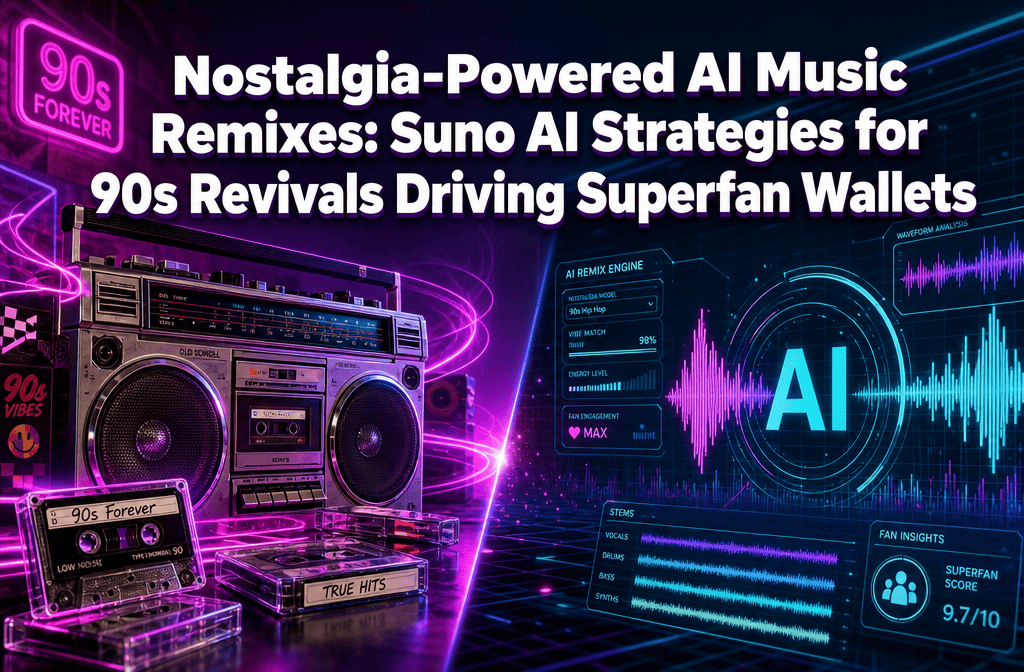
- Nostalgia-powered AI music remixes: Suno AI strategies for 90s revivals driving superfan wallets work best when paired with exclusive access models like digital membership cards and tiered fan communities
What Exactly Is Suno AI and How Does It Remix Old Music?
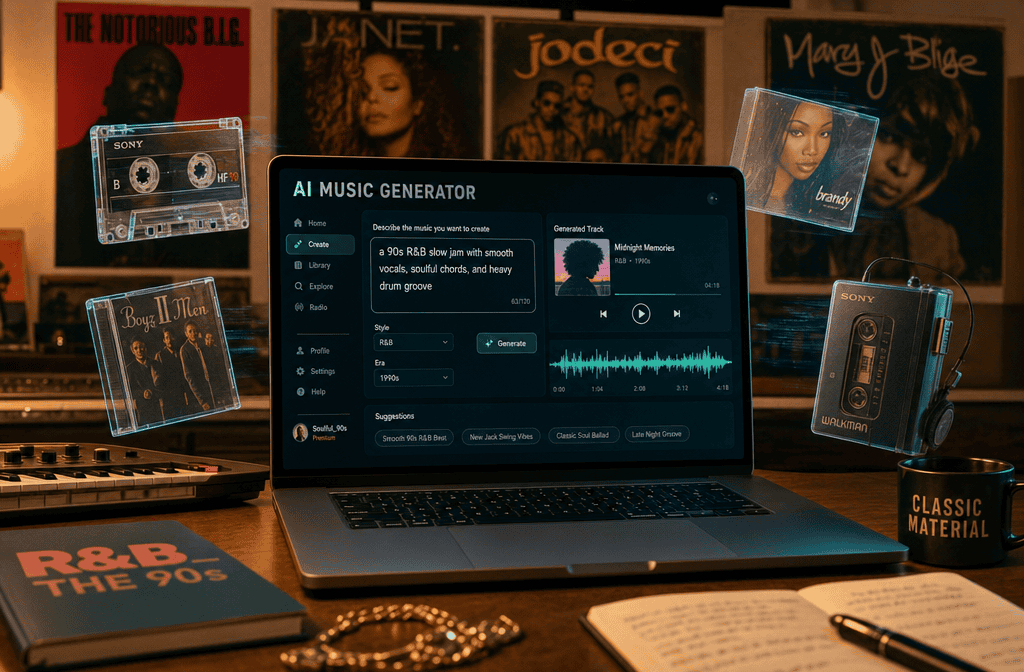
Suno AI is a text-to-music generation platform that creates full songs—vocals, instrumentation, and production—from written prompts. It doesn’t remix existing recordings. Instead, it generates entirely new tracks that can closely match the sonic characteristics of specific eras, genres, and production styles.
With the v5.5 release in late March 2026, Suno introduced features like Voices, Custom Models, and “My Taste,” which learn from a user’s listening profile to recreate highly targeted retro micro-genres [2]. So when an artist types a prompt describing “90s boom-bap hip-hop with dusty vinyl crackle and a jazz piano loop,” Suno generates an original track that feels like 1996 without sampling any copyrighted material.
This distinction matters. Suno doesn’t pull from existing songs. It produces new audio based on pattern recognition from its training data. For a deeper dive into crafting effective generation prompts, check out our complete guide to music prompts for Suno.
How Much Does Suno AI Cost to Generate Nostalgic Music Tracks?
Suno offers three tiers, and the pricing directly affects whether generated tracks can be monetized:
| Plan | Monthly Cost | Credits/Month | Commercial Rights |
|---|---|---|---|
| Basic | Free | 50 credits/day | Non-commercial only |
| Pro | ~$10 | 2,500 credits | Yes—commercial use allowed |
| Premier | ~$30 | 10,000 credits | Yes—commercial use allowed |
The critical detail: tracks must be generated while subscribed to a paid plan to qualify for commercial use. If an artist creates a 90s-style track on the free tier, that track cannot legally be sold, streamed for revenue, or used in a membership offering. For artists building a superfan monetization strategy, the Pro plan is the minimum entry point.
At $10/month, the cost-to-output ratio is strong. A single well-crafted nostalgic track offered as an exclusive digital collectible can recoup that investment many times over.
Can I Legally Sell AI-Generated Music Remixes From the 90s?
Yes, but with major caveats. In March 2026, the U.S. Supreme Court declined to hear Stephen Thaler’s appeal on AI authorship, confirming that works created entirely by AI cannot be copyrighted [10]. This means a track where Suno does all the work and the human only types a prompt likely has no copyright protection.
The practical fix: add substantial human authorship. That means writing original lyrics, performing vocals over AI instrumentals, arranging multiple AI-generated stems into a new composition, or mixing and producing the output significantly. The more human creative input, the stronger the copyright claim.
Additionally, the proposed CLEAR Act would require AI companies to disclose copyrighted works used in training, which raises compliance stakes for platforms generating “sound-alike” nostalgia aesthetics. For a full breakdown of what’s legal and what isn’t, see our AI music generator legal and ethical monetization guide.

How Do Copyright Rules Work With AI Music Generation?
AI-generated music sits in a gray zone, but the rules are getting clearer. Pure AI output = no U.S. copyright protection [10]. Human-augmented AI output = potentially copyrightable, depending on the degree of human contribution.
Key rules to follow:
- Never replicate a specific artist’s voice without permission (right-of-publicity laws still apply)
- Don’t use prompts that name copyrighted songs (e.g., “remix Waterfalls by TLC”)—generate style-inspired tracks instead
- Always generate on a paid Suno tier if the track will be monetized [2]
- Document the human creative contributions made to each track
- Labels are watching: Forbes reported that Suno, now valued at approximately $2.5 billion, “is battling record labels and angry artists” over AI-driven catalog creation [3]
Common mistake: Assuming that because Suno generated the track, Suno owns it. On paid plans, Suno grants commercial rights to the user. But without copyright protection for pure AI output, anyone could theoretically copy and redistribute the same track. Human authorship is the shield.
What Are the Best Genres for Nostalgia-Driven AI Music Remixes?
90s genres with distinctive, recognizable production signatures perform best because they trigger instant emotional recognition. The top performers for superfan engagement in 2026:
- 90s R&B (slow jams, new jack swing): Rich vocal harmonies and warm analog textures
- Eurodance: Synth-heavy, high-energy beats that dominate throwback playlists
- Grunge/Alternative Rock: Distorted guitars and raw vocal tones
- Boom-bap Hip-Hop: Dusty samples, hard drums, jazz-influenced loops
- 90s Pop: Bright melodies, catchy hooks, polished production
- Trip-Hop/Downtempo: Moody, atmospheric—great for AR listening experiences
Choose the genre based on the target fan community. A hip-hop artist building a direct fan revenue strategy should lean into boom-bap nostalgia. A pop artist might find more traction with Eurodance or bubblegum pop aesthetics.
Who Are the Target Fans Most Likely to Buy AI Nostalgia Music?
The sweet spot is Millennials aged 30–42 and older Gen Z (22–29) who experience what psychologists call “vicarious nostalgia”—longing for eras they barely or never lived through. Research shows approximately 68–73% of Gen Z adults report nostalgia for times before their own, and 78% want new technologies that integrate past design elements.
The ideal superfan profile:
- Actively engages with 90s throwback content on TikTok and Instagram
- Already spends on vinyl, retro merch, or streaming playlists curated by era
- Values exclusivity and community membership
- Responds to “comfort content” that blends familiar sounds with fresh production
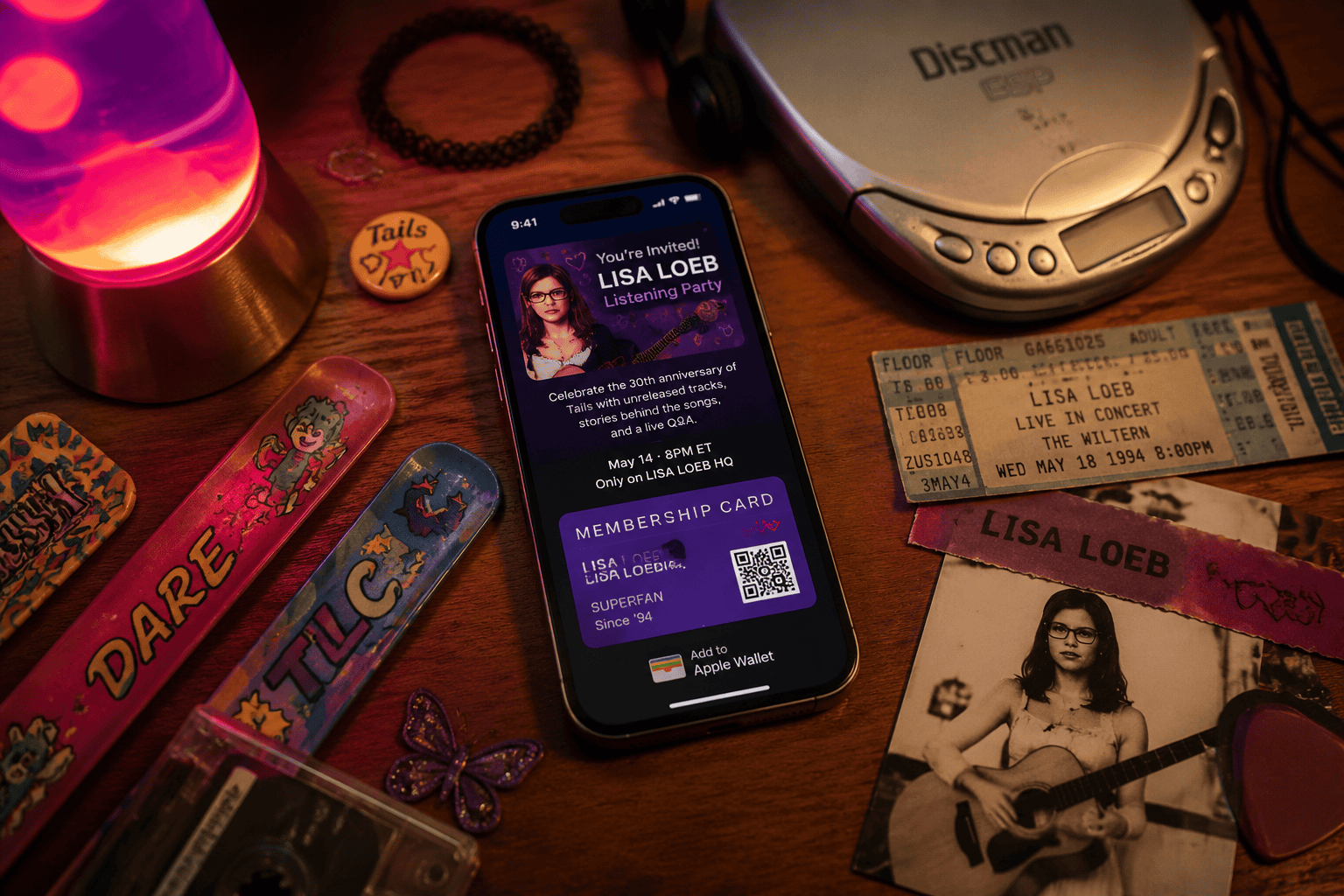
This is where digital membership cards become powerful. Artists can gate exclusive 90s-style AI tracks behind membership tiers, creating a recurring revenue loop. Pair this with AR listening parties on Instagram—where fans experience the track together in real time—and the emotional connection deepens without relying on gamified challenges.
Can Suno AI Recreate Specific Band Styles From the 90s?
Suno can approximate the sonic aesthetic of 90s-era production styles, but it won’t (and shouldn’t) clone a specific artist’s identity. The v5.5 Custom Models feature lets users train on their own preferences to dial in era-specific characteristics like reverb depth, drum machine patterns, and synth textures [2].
What works: Prompting for “mid-90s Seattle alternative rock with heavy distortion, baritone vocals, and lo-fi recording quality.”
What doesn’t work (and is risky): Prompting for “a song that sounds exactly like Nirvana” or “make this sound like Aaliyah.” That crosses into right-of-publicity territory and could trigger legal action.
The strategy is to capture the era, not the artist. Fans respond to the feeling of the decade, not a specific imitation.
Are AI Music Remixes Good for Marketing or Just Personal Use?
They’re a legitimate marketing tool in 2026. AI-generated tracks have already reached TikTok’s Viral 50—”A Million Colors” by Vinih Pray hit No. 44 on TikTok’s viral chart, proving real audience traction for AI-native music [4].
For independent artists, 90s-coded AI tracks work as:
- Lead magnets to grow email and SMS lists
- Exclusive content for fan loyalty programs
- Background music for Reels and short-form video content
- AR listening party soundtracks on Instagram that drive direct engagement
- Merchandise tie-ins where limited-edition tracks pair with physical drops
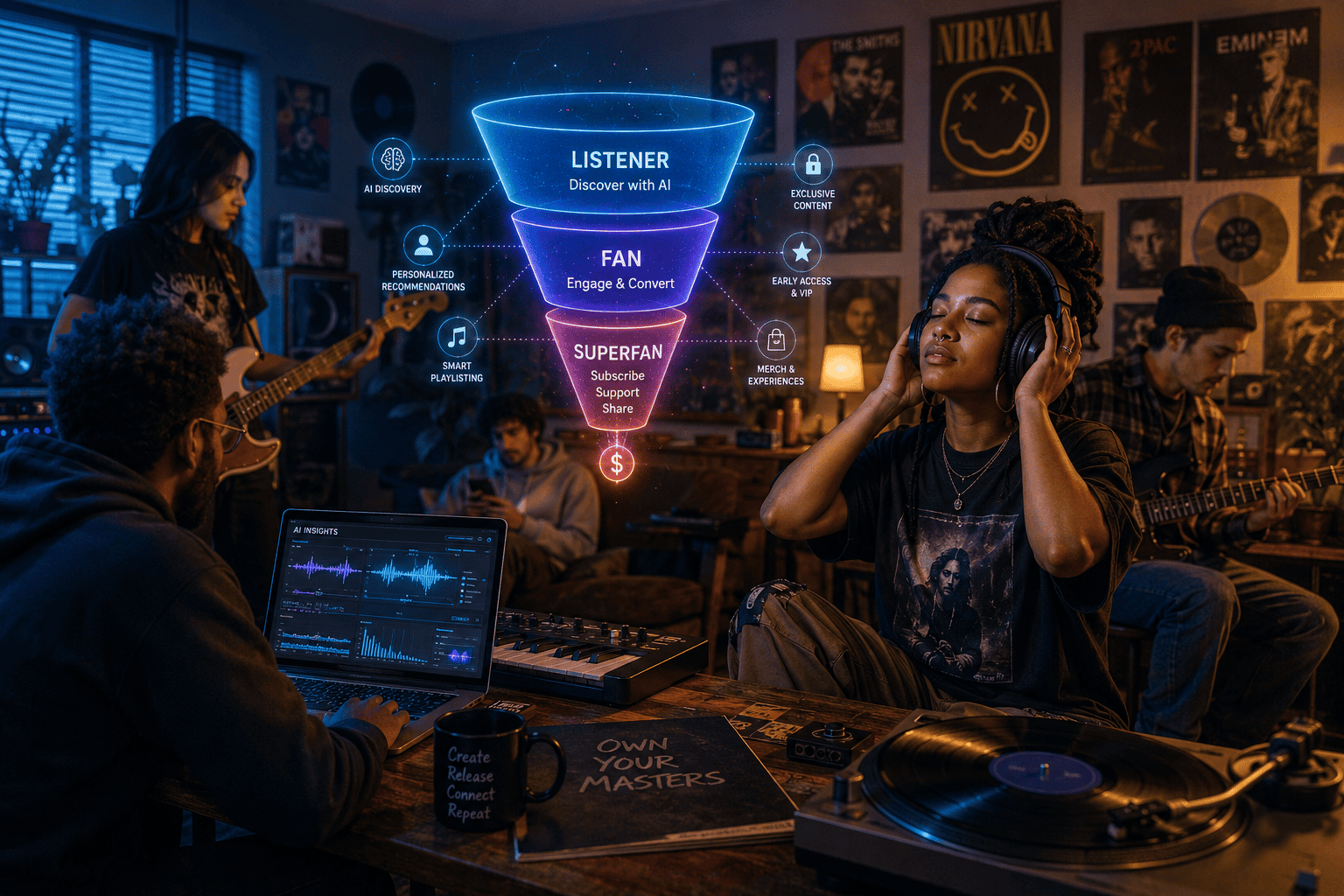
The key is treating AI-generated nostalgia tracks as assets in a fan funnel, not standalone products. They move listeners from casual discovery to paid superfan status. Learn more about building that pipeline in our superfan co-creation strategies with Suno AI.
What Technical Skills Do I Need to Use Suno AI Effectively?
No music production experience is required to start. Suno’s interface is prompt-based—type a description, and it generates a track. But better results come from:
- Prompt specificity: Naming exact production elements (e.g., “808 kick, hi-hat rolls, pitched-down vocal sample”) rather than vague descriptions
- Basic audio editing: Trimming, layering, and mixing Suno outputs in a DAW to add human authorship
- Genre literacy: Knowing what made 90s sub-genres distinct helps write better prompts
- Iteration patience: Generating 10–20 variations and selecting the best outputs
Common mistake: Accepting the first generation. The artists seeing real results treat Suno like a brainstorming partner, not a finished-product machine. Generate, refine, add human elements, repeat. For prompt-writing techniques, our Suno prompt guide covers this in detail.
How Are Music Labels Responding to AI Remix Technologies?
Major labels are split between litigation and partnership. Forbes reported that Suno’s $2.5 billion valuation has made it a target—labels argue that AI training on copyrighted catalogs constitutes infringement [3]. At the same time, some labels are exploring partnerships to license their catalogs for AI training, recognizing the revenue potential [8].
For independent artists, this tension is actually an advantage. While majors fight over ownership of AI-generated content, indie creators can move fast, build fan communities around exclusive nostalgic content, and establish direct revenue streams that don’t depend on label infrastructure.
What Are the Ethical Considerations of AI Music Generation?
Three ethical dimensions matter most:
- Attribution: Be transparent with fans about AI involvement in the creative process. Audiences respect honesty.
- Artist displacement: Use AI to supplement creativity, not replace human musicians. The strongest approach combines AI generation with live performance, original vocals, and human arrangement.
- Data privacy: Suno’s updated privacy policy (post-February 2026) collects prompt and conversation data to improve its models [2]. Every nostalgic era description fed into the system trains future outputs. Artists should be aware of this trade-off.
The ethical path forward: use AI as a tool in a larger creative vision, credit the technology’s role, and ensure human artistry remains at the center.
Can Suno AI Help Independent Musicians Monetize Nostalgia?
Absolutely—and this is where nostalgia-powered AI music remixes: Suno AI strategies for 90s revivals driving superfan wallets become a real business model, not just a creative experiment.
The monetization playbook:
- Generate 90s-style tracks on Suno’s Pro or Premier tier with detailed era-specific prompts
- Add human authorship (original lyrics, vocals, arrangement) to strengthen copyright claims
- Gate tracks behind digital membership cards for exclusive access
- Host AR listening parties on Instagram where members experience new drops together
- Bundle nostalgia tracks with merch for higher average order values
- Use throwback content on Reels and TikTok to attract new listeners into the fan funnel
The generative AI music market is projected to hit $2.79 billion by 2030. Independent artists who build nostalgia-driven superfan ecosystems now are positioning themselves at the front of that wave. For broader strategy, explore our music marketing strategy for 2026.
Conclusion
Nostalgia-powered AI music remixes: Suno AI strategies for 90s revivals driving superfan wallets represent one of the most accessible revenue opportunities for independent artists in 2026. The tools are affordable. The audience is hungry for retro-coded content. And the superfan infrastructure—digital membership cards, AR experiences, exclusive drops—already exists.
Your next steps:
- Sign up for Suno Pro ($10/month) and start generating 90s-style tracks with specific, detailed prompts
- Add meaningful human creative elements to every track before monetizing
- Build a membership tier that gates exclusive nostalgic content for paying superfans
- Test AR listening parties on Instagram to deepen emotional connection
- Track which 90s sub-genres resonate most with your audience and double down
The 90s aren’t coming back. They’re being rebuilt—by artists like you, with tools that didn’t exist two years ago. Own the nostalgia. Own the revenue.
FAQ
Can I use Suno AI for free to make 90s-style tracks? Yes, but free-tier tracks cannot be used commercially. Any track intended for sale, streaming revenue, or membership content must be generated on a paid plan ($10/month minimum) [2].
Will AI-generated 90s music sound authentic enough for fans? Suno v5.5’s Custom Models and “My Taste” features produce era-specific tracks that closely match 90s production aesthetics. Results improve significantly with detailed, genre-literate prompts [2].
Can I get sued for making AI music that sounds like a 90s band? Capturing a general era aesthetic is different from imitating a specific artist. Avoid naming artists in prompts, and don’t clone recognizable voices. Style itself isn’t copyrightable, but identity is protected.
Do I own the AI music I create on Suno? On paid plans, Suno grants commercial use rights. However, pure AI output likely can’t be copyrighted in the U.S. [10]. Adding substantial human authorship strengthens ownership claims.
What’s the best way to sell AI-generated nostalgia tracks? Gate them behind digital membership cards, bundle with merch, or offer as exclusive content in fan communities. Direct-to-fan sales outperform streaming-only distribution for niche nostalgic content.
How many tracks can I generate per month on Suno Pro? The Pro plan includes approximately 2,500 credits per month. Each full song generation uses a portion of those credits, typically allowing dozens of complete tracks monthly.
Are AI nostalgia remixes a fad or a real business model? The generative AI music market is projected to grow at 30.5% CAGR through 2030. Combined with data showing 80% of Millennials and Gen Z respond to nostalgia-driven content, this is a durable trend with real revenue potential.
Do I need music production skills to use Suno? No production skills are needed to generate tracks. But basic audio editing skills help add human authorship, which strengthens both quality and copyright protection.
References
[2] Blog – https://suno.com/blog [3] Inside Sunos 25 Billion Bet That Ai Made Music Is Here To Stay – https://www.forbes.com/sites/rashishrivastava/2026/04/30/inside-sunos-25-billion-bet-that-ai-made-music-is-here-to-stay/ [4] SelfSound – https://selfsound.com/ai-news/ai-music-news-april-252026/ [8] Suno Adjusts Ai Music Ownership Terms After Warner Music Partnership – https://www.musicinafrica.net/magazine/suno-adjusts-ai-music-ownership-terms-after-warner-music-partnership [10] Watch – https://www.youtube.com/watch?v=KWPOAt0GhmM